Saint-Florent gets called the Saint-Tropez of Corsica, and you understand why walking past the marina at sunset — white sailing yachts, terraces full of people, a gulf turning pink in the last light. But the comparison ends as soon as you walk a few streets inland. Then it's just a Corsican harbour town: a citadel above, a market on the square, and the wind blowing in from the Patrimonio vineyards.
Saint-Florent: at the foot of the Nebbio
Saint-Florent sits on a deep bay on Corsica's north coast, wedged between the Cap Corse peninsula to the east and the Désert des Agriates to the west. Behind the town the gentle hills of the Nebbio rise — a wine region known for centuries for its robust reds.
The town itself is small — fewer than two thousand residents — but in July and August the population swells many times over. The marina is one of the busiest on the north coast, with boats stopping to refuel before continuing on to the Sardinian and Italian beaches.
Tip Saint-Florent is busier in July and August than many people expect. Don't just walk along the harbour — the side streets behind the main drag have quieter restaurants and lower prices.
The citadel and the old town
Above the harbour stands the Genoese citadel from 1440, a round fortress that defended the town for centuries against Saracen raids. It's not a grand stronghold like Calvi or Bonifacio — more a sturdy defensive tower — but you can walk around it and the view over the harbour is good, especially late in the afternoon.
The old centre is compact and built in soft yellows and whites — a lighter palette than the grey granite of many other Corsican towns. The Cathédrale du Nebbio (officially Santa Maria Assunta) sits just outside the town, about a kilometre towards Patrimonio. It's a Romanesque chapel from the twelfth century, built in cream-coloured limestone, and walking around it you get the feeling you've found something that doesn't quite belong anywhere anymore.
Tip Combine the cathédrale with lunch at a wine domain in Patrimonio. Many domains like Domaine Antoine Arena and Clos Marfisi receive visitors for tastings, and some offer a small menu of local produce.
The Patrimonio vineyards
Just east of Saint-Florent lies the Patrimonio AOC, Corsica's oldest and best-known wine region. The hills here are blanketed in vineyards of Nielluccio (red, related to the Italian Sangiovese) and Vermentino (white). The robust, unfussy Patrimonio reds pair beautifully with Corsican charcuterie and game.
A handful of domains worth a stop:
- Domaine Antoine Arena — organic, small, well-respected
- Clos Marfisi — generations in the same family
- Yves Leccia — modern style, premium
- Orenga de Gaffory — larger, with a museum and art exhibitions
Most domains receive visitors in July and August without an appointment for tastings; outside high season it's wise to call ahead.
Beaches and excursions
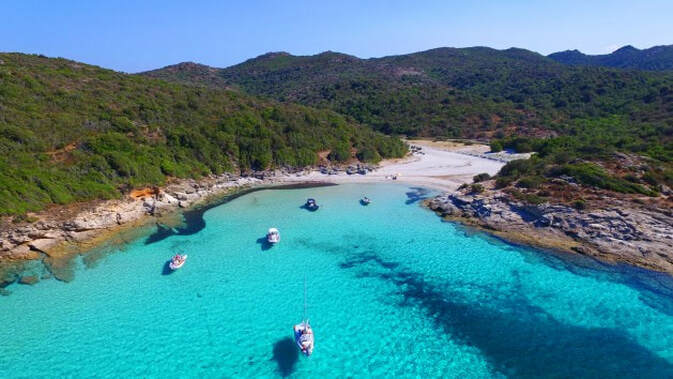
Saint-Florent is the logical base for the beaches of the Désert des Agriates, especially Plage de Saleccia and Plage du Lotu. Boats run several times a day from the harbour (April to October), with crossings of about twenty minutes to Lotu and a bit longer to Saleccia. Allow €15-25 per person return.
If you'd rather sail than drive, you can also book trips from Saint-Florent to Plage du Lodo or along the west coast of Cap Corse.
Tip Take the boat one way and walk back? A coastal path runs from Saleccia back to Saint-Florent through the Désert. Allow five to six hours, not strenuous but completely without shade — only do it with enough water and not in the heat of the day.
Eating and going out
The marina has the most restaurants, but as everywhere on the coast value varies. For good fish: La Marinuccia or L'Aliva, both close to the quay. For pasta with local ingredients: L'Auberge du Pêcheur.
Behind the main drag, in Rue de la Citadelle and the side streets, you find smaller places that are often quieter and cheaper. Ask at the morning market — locals know where Corsicans actually eat.
Practical
- Getting there: about 25 minutes from Bastia via the D81 — a beautiful coastal road over the Col de Teghime with views of both sides of the island.
- Parking: July and August it's paid in and around the harbour, around €2/hour. Outside the high season it's easier.
- When to go: May and September are loveliest — warm, in bloom, and the beaches without high-season crowds.
- Sleeping: a handful of small hotels in town, plus campsites and gîtes in the hills around Patrimonio. Reserve in peak season.
- Combine with: Cap Corse (a day's drive), Désert des Agriates (by boat or 4×4) and the Balagne (1.5 hours west).