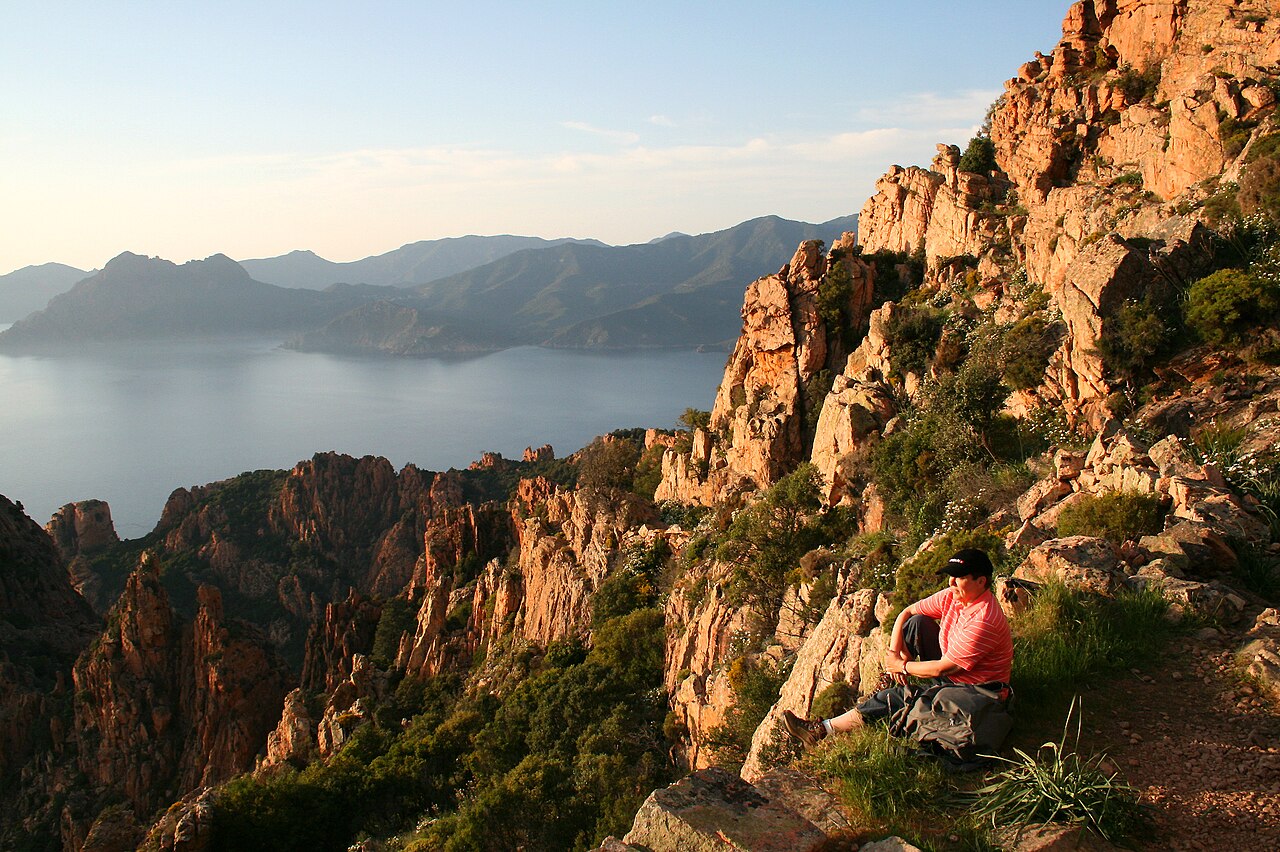
Scandola is one of the three places in Corsica where you really don't have words in the moment. The red cliffs rise hundreds of metres straight out of the water, the water below is so clear you can look ten metres down, and you approach all of it from a boat — there are no roads in. That's exactly why it's so well preserved.
What Scandola is
The Réserve Naturelle de Scandola is a 1,919-hectare nature reserve on Corsica's north-west coast, between Punta Muchillina and Punta Nera, on the Scandola peninsula. The reserve was established in 1975 and added to the UNESCO World Heritage List in 1983 — one of the few places in Europe with that double protection, both on land and at sea.
The rocks are red rhyolite and basalt, formed by volcanic activity millions of years ago and shaped by erosion into cliffs, arches, caves and sea stacks. Below the surface the reserve continues: 1,000 hectares of protected sea with a wealth of posidonia seagrass meadows, coral and fish life that has become rare elsewhere in the Mediterranean.
Tip Scandola can only be visited by boat. Walking or swimming inside the reserve is prohibited. Mooring is allowed only at a few designated spots; everywhere else, looking from the water is the deal.
How to get there
Boat trips to Scandola depart from three places:
- Porto — the most common. Half an hour to Scandola. Tours last 2-3 hours (Scandola only) or a half day (Scandola + Girolata).
- Calvi — longer crossing (1.5-2 hours one way), usually a full day. Bigger boats, useful when Porto is full.
- Cargèse and Sagone — smaller harbours, often quieter boats with fewer people.
Different types of boats:
- Larger excursion ships — €40-55 per person, often covered, sometimes with audio guide
- Small semi-rigid boats (zodiacs) — €60-80, faster, closer to the rocks, smaller groups, better for photos
Allow half a day to a full day, depending on the tour. In July and August booking a day ahead is essential; outside the high season you can usually reserve the same morning.
Tip Go early in the morning. The sea is calmer, the light softer, and you avoid the crowds of midday tours. Helpful too if you're prone to seasickness — the sea is often choppier after 11.
What you see along the way
The route to Scandola from Porto takes you past the Calanques de Piana — the same red rock formations you see from the D81 above, but from the sea they look completely different. Then the boat passes high cliffs, through caves like the Grotte Bleue (where light reflects in through the water), and between rocky islets where seabirds nest.
Along the way you'll almost certainly see:
- Ospreys (Pandion haliaetus) — Scandola has one of the largest breeding populations in the Mediterranean
- Cormorants with their characteristic black silhouette
- Sometimes dolphins swimming alongside the boat
If the tour stops at Girolata, you'll moor there for an hour or more.
Girolata: the village without a road
Girolata is a hamlet of a handful of houses, a sixteenth-century Genoese fort and three or four restaurants — accessible only by boat or via a 1.5-hour walking trail from the Col de la Croix. No road, no mains electricity (only generators and solar), and in winter almost deserted.
Many boat tours stop for lunch. The fish here is as fresh as it gets — straight out of the water in front of you — but prices are steep. If you want to keep it cheap, bring a packed lunch and sit on the beach.
Tip Want to see Girolata without a boat trip? The walk from the Col de la Croix (on the D81 between Porto and Galéria) takes 1.5 hours down, two hours back up. Not strenuous, but plenty of altitude. Do it in the morning, lunch in Girolata, walk back.
When and how long
- Boats run from April to October, with daily departures in July and August
- Best months: June and September — less busy, clear water, calm sea
- Avoid: days with maestrale (the north-westerly). The sea gets rough then and trips are cancelled or simply unpleasant. Check the forecast — wind above 5-6 Beaufort usually means cancellation
Practical
- Booking: in peak season via Compagnie des Promenades en Mer in Porto, or directly with operators on the quay
- Bring: sunscreen (the wind hides the burn), cap, sunglasses or wind glasses, water, a light layer for the boat
- Combine with: a day in Porto itself, a hike through the Calanques de Piana, or a visit to Cargèse
- Don't: swim or dive in the reserve's core zone (clearly marked everywhere). Fines are steep and surveillance is real