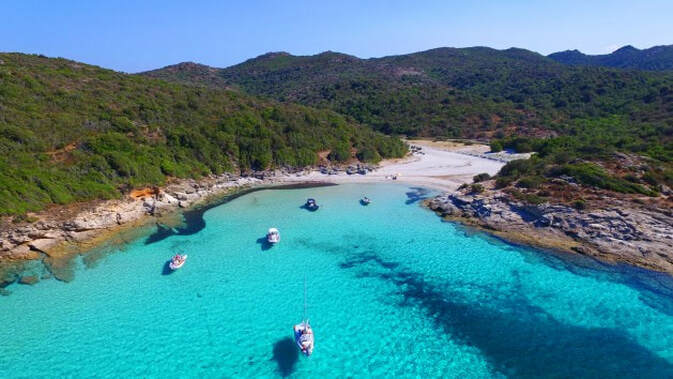
It's not a desert. But when you're driving the dusty track to Saleccia, with an hour of nothing around you except maquis, boulders and the occasional free-roaming cow, you understand why the name sticks. This is the one part of Corsica with no road, no village and barely any people. And yet at the end of it lies one of the island's most beautiful beaches.
What it is, and what it isn't
The Désert des Agriates is a 15,000-hectare nature area on the north coast of Corsica, wedged between Saint-Florent to the east and the Balagne to the west. The name ("desert") is misleading — things grow here, plenty: dense maquis of rosemary, myrtle, lavender, mastic and wild olive. Twelve rivers and thirty-two springs cross the area. It only looks empty because no-one lives in it.
For centuries the Agriates was actually intensively cultivated: grain, olives, sheep. The name itself comes from the Latin agrarius (agriculture). In the twentieth century the farming faded — people left, the maquis took over — and since 1979 it's been a protected area. The free-roaming cattle are a lasting legacy: they're not wild but they're loose, and turn out to be alarmingly fond of bread.
Tip Keep your distance from the loose cows — they look calm but aren't used to people. Camping on the beach: don't leave food in a tent, even at night.
Three ways into the Agriates
1. By boat from Saint-Florent
The easiest. Boats run from April to October out of Saint-Florent harbour, with several departures a day. The crossing to Plage du Lotu is about twenty minutes; to Plage de Saleccia a bit longer. Allow €15-25 return. In peak season book a day ahead.
2. By 4×4 over the track
The inland route to Saleccia is an unpaved track of about 12 km off the D81. The track starts at Casta. Allow an hour each way in a 4×4 or a competent crossover; standard cars usually don't make it — it's not a road, it's rocks, holes and dust. Rental companies often forbid driving here. Guided 4×4 tours leave from Calvi, Saint-Florent and Bastia.
3. On foot
The coastal path runs from Saint-Florent to Ostriconi, about 35 km and typically split over three days. Along the way you pass restored shepherds' huts (bergeries) where you can sleep. Shorter sections work too: Saleccia back to Saint-Florent is six hours, not strenuous but completely without shade — only do it early morning or late afternoon, with enough water (minimum three litres per person).
Tip The combination of boat-out, walk-back is the right compromise for many people. Boat in the morning to Lotu or Saleccia, a few hours on the beach, then walk back in the late afternoon when the worst of the sun is gone.
The beaches
Plage de Saleccia — white sand, kilometres long, turquoise water. Famous for its scenes in the film The Longest Day (1962), shot here because Saleccia looks like a Normandy beach without the crowds. No shade or facilities except for a basic beach bar in high season.
Plage du Lotu — smaller and more sheltered than Saleccia, looking out over Cap Corse. More often calm water, sandier bottom. There's a basic beach bar with drinks and light snacks.
Plage de l'Ostriconi — at the western exit of the Agriates, easier to reach than Saleccia (just by car). Wide river mouth, dramatic rock formations, popular with windsurfers.
Hiking routes
Beyond the coastal path there are shorter walks into the interior. From the Maison du Désert at Casta, two- to three-hour loops set off into the maquis, with information about the local flora. In bloom (April and May) the whole air smells of lavender and myrtle.
For more: the three-day Sentier des Douaniers (customs officers' path) from Saint-Florent to Ostriconi. Three stages of 8-12 km along the coast, with overnight stops in shepherd's huts maintained by the Agriates managers. Booking essential via the Conservatoire du Littoral.
Tip For a day walk with no commitment: park at Casta, walk an hour inland, eat a packed lunch on a rocky outcrop, walk back. No prep needed, and the area's yours.
When to go
- Best months: May, June and September. May especially when it's all in bloom.
- Avoid: July and August for hiking — temperatures climb well above 30°C with no shade, and the beach gets busier than the name suggests.
- Maestrale: the north-westerly can blow for days. Boats stop running, the beach gets covered in posidonia (seagrass). Not much to do but wait it out.
Practical
- Getting there: car from Bastia (40 min), Saint-Florent (10 min), Calvi (1.5 hrs), or the boat from Saint-Florent
- Food and drink: virtually no facilities in the area itself. Bring it all, water above all
- Sleeping: legal camping at designated spots inside the Agriates (Plage du Lotu and some bergeries). Wild camping is forbidden and enforced
- Combine with: Saint-Florent or the Patrimonio vineyards, or onward into the Balagne