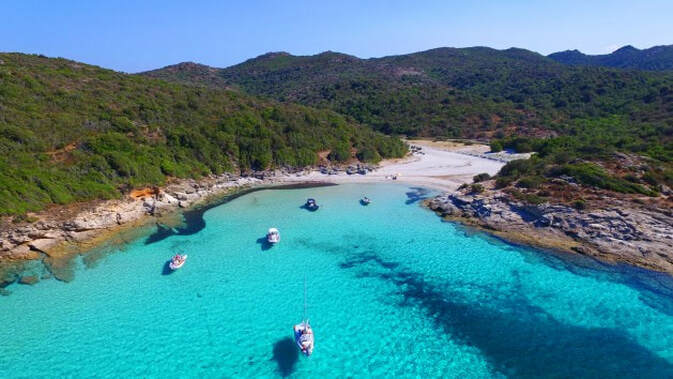
Every beach in Corsica has a slightly different face. One is wide, shallow and perfect for a day with kids. Another is a bay with white rocks and clear water. A third is an hour's walk from the nearest car park. Below: which beach fits which situation, with links to the pages where the details live.
Going with kids
What you want: shallow water that deepens slowly, soft sand without rocks, and parking that isn't impossible.
Best picks:
- Plage de Santa Giulia — a shallow lagoon south of Porto-Vecchio. The water stays very shallow for a long way out. Watersports rentals, terraces, full facilities. Crowded in peak season.
- Plage de Palombaggia — fine light-coloured sand, parasol pines for shade, shallow shoreline. Family-friendly but in July/August you fight for space.
- Plage de Calvi — nearly six kilometres long, fine sand, calm clear water. City beach, so facilities are within walking distance.
The full list is on top 10 family beaches.
Insider tip For small children shallow water matters most, but shade is a close second. Palombaggia has the best shade thanks to the pines. At Santa Giulia, bring your own parasol.
Looking for quiet
What you want: fewer people, no speakers, the feeling you've found something.
Best picks:
- Saleccia and Lotu — in the Désert des Agriates, between Saint-Florent and the Balagne. Reachable via a long unpaved track or by shuttle boat from Saint-Florent. White sand, few facilities, few people.
- Plage de Rondinara — a round bay between Bonifacio and Porto-Vecchio. Sheltered, clear water, and despite its fame still often calm outside July and August.
- Plage de Bodri and Plage de l'Arinella (Balagne) — smaller bays between Calvi and L'Île-Rousse, reachable by the narrow-gauge train. Effortless quiet.
Insider tip Quiet plus accessibility is always a trade-off. Saleccia is famous for its calm, but you pay for it in time or in a bumpy ride. Bodri is almost as quiet and you just step off a small train.
Snorkelling
What you want: clear water, rocks below the surface, fish to see.
Best picks:
- Snorkelling beaches — overview of the best snorkelling spots, mostly around Bonifacio and Porto-Vecchio.
- The Lavezzi islands (boat from Bonifacio) — protected marine area, white rocks, crystal-clear water. Worth a day trip.
- Cala di Roccapina (south-west coast) — rougher, with good snorkelling pockets at the rocky ends of the bay.
Insider tip Early morning means calmest water and best visibility underneath. From around 11:00 the wind picks up and the surface gets choppy.
The picture-of-the-trip beach
What you want: a view or composition you'll be talking about for years.
Best picks:
- Plage de Rondinara — from the hill above the beach you look down onto an almost perfectly round bay with turquoise water.
- Nonza — not really a sunbathing beach, but the most dramatic black-sand beach on the island, with the village and tower above.
- Plage de Saleccia (Agriates) — the iconic untouched beach from the brochures, with white dunes and parasol pines.
First time in Corsica, picking just one beach
First trip, one beach day, no time to plan side roads or boats? Go to Palombaggia. It's the beach that built Corsica's reputation, and arriving early in the morning you'll see why. Combines well with lunch in Porto-Vecchio and an evening in Bonifacio.
By region
A quick overview per area:
- Beaches in the north — Agriates, Saint-Florent, Cap Corse. Wilder, often rougher, fewer facilities.
- Beaches in the south — Porto-Vecchio area, Bonifacio. Postcard Corsica.
- Balagne — Calvi, L'Île-Rousse and smaller coastal bays. Good mix of accessibility and quiet.
What actually makes the difference
Almost nobody comes to Corsica for one beach. The difference between a good and a great beach day on this island isn't really which beach so much as when you go. Early morning or after four in the afternoon. Outside July and August. With enough water packed. Not too close to the main routes.
So pick your moment first, then the beach. The practical pages on parking and the weather help more than any top-10 list.