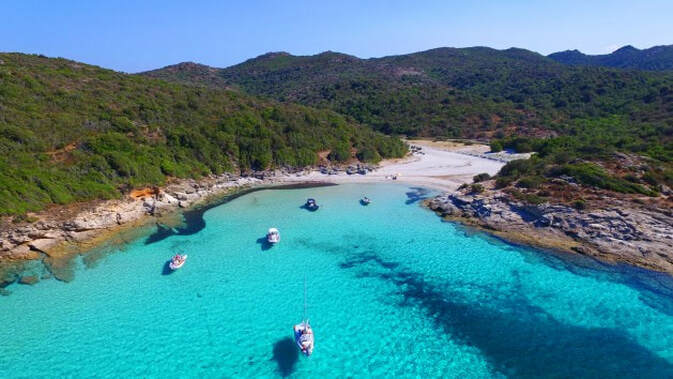
Saleccia is one of those places you see on travel-agency posters and think: it can't actually look like that. And then you stand on the white sand bank between the pines, with turquoise water in front of you and nothing behind you except maquis stretching to the mountains — and somehow it does. A beach that delivers on its reputation.
What makes the beach special
Plage de Saleccia sits in the middle of the Désert des Agriates on the north coast of Corsica, about 15 km west of Saint-Florent. The beach is nearly a kilometre and a half long, with fine white sand and a gently sloping floor that fades into clear turquoise water. Behind the beach stand umbrella pines providing shade pockets in summer, and behind them the maquis stretches to the mountains on the horizon.
What sets Saleccia apart from the famous southern beaches is the absence of infrastructure. No hotels, no waterfront restaurants, no rentable loungers, no overflowing car park. There's a basic beach bar in high season, and otherwise you're on your own.
Tip Saleccia is famous, but the difficulty of getting there filters out enough people that even in high season it doesn't feel like a tourist beach. Compare that to Palombaggia in July — completely different experience.
The history
Saleccia has an unexpected history. During the Second World War, the French submarine Casabianca delivered weapons to the Corsican resistance here in 1943. And in 1962, scenes for the war film The Longest Day (about D-Day) were shot here — Saleccia looked enough like the Normandy beaches to do the filming here, without the crowds of the actual Normandy coast.
How to get there
Three ways, with widely different difficulties:
1. Boat from Saint-Florent (easiest)
Boats leave several times a day from late March to late October from the harbour at Saint-Florent. The crossing takes around 30-40 minutes. There's a direct service to Saleccia or a combined trip that also stops at Plage du Lotu. Allow €20-30 per person return. Book in July and August.
2. By 4×4 over the track
The inland route via the D81 from Casta runs over 12 km of unpaved track through the Agriates. Doable in a 4×4 or sturdy crossover — allow an hour each way. A regular car won't make it — it's rocks, holes, dust, and mud after rain. Rental companies often forbid driving here; check your contract.
3. On foot along the coast
From Saint-Florent the Sentier du Littoral coastal path runs to Saleccia in 5-6 hours. The path is well-marked, not strenuous but completely without shade. Three litres of water per person, an early start, and don't do it in the heat of the day.
On the beach
Once at Saleccia: the beach is open and wide enough that you'll always find your own spot. The sand is fine and white, not the gritty kind. The water is crystal clear and stays shallow for a long way out — ideal for kids, with the caveat that there are no lifeguards and waves can suddenly be stronger than expected when the wind picks up.
At the northern end of the beach a rocky outcrop begins where you can do reasonable snorkelling — not Lavezzi-level, but fish weave between the rocks and the granite formations underwater are striking.
In high season there's a basic beach bar with drinks, ice creams and light snacks. Otherwise nothing — no toilets, no loungers, no facilities.
Tip The umbrella pines behind the beach offer the only natural shade. Arriving by boat around 11:00, the shaded spots are often already taken. Your own parasol or wind shield is a good investment.
Posidonia: the small annoyance
You'll often see piles of brown seagrass on the beach, sometimes metres deep. That's posidonia oceanica, a protected seagrass that plays an important role in the marine ecosystem (filtering water, oxygen, fish habitat). Beaches in the Agriates aren't combed clean like the southern tourist beaches — the seagrass stays, protects the sand from erosion, and is just part of the natural landscape.
For some visitors it looks ugly; for others it belongs. Either way, after a storm the beach can be covered for a few days before the wind clears it again.
Saleccia or Lotu?
Plage du Lotu lies 2 km east of Saleccia and is an alternative — smaller, more sheltered, often calmer water. Slightly easier to reach (shorter boat trip, closer to the landing point). With a full day you can walk from Lotu to Saleccia in an hour along the coastal path. Many boat trips offer a combination ticket.
Practical
- Getting there: boat from Saint-Florent (easiest), 4×4 over the track (adventurous), or on foot (long day)
- When: May-June and September are ideal. In July and August the beach is still calm, but boats fill up
- Bring: water (none on the beach), sunscreen, parasol or windbreak, picnic, snorkel gear
- Sleeping: legal camping is allowed at Plage du Lotu (campsite) — not at Saleccia. Otherwise Saint-Florent or the hills around Patrimonio
- Combine with: a morning in Saint-Florent, a wine tasting in Patrimonio, or a 4×4 tour through the whole Désert des Agriates